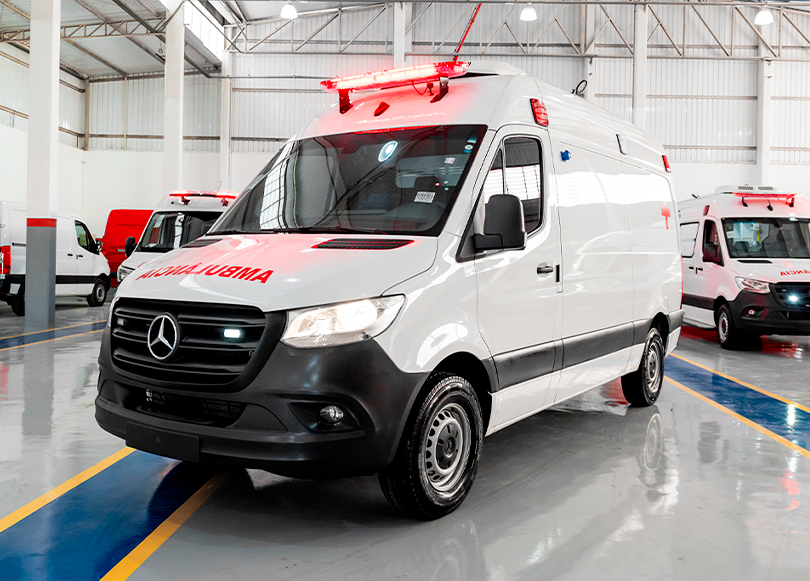
VEHICLE TYPE ICU AMBULANCE WITH EQUIPMENT – VAN – MINIMUM 10.5 m³ – 0 KM
New van-type vehicle, zero km, adapted for ICU ambulance with equipment, with a maximum power of at least 160 hp; PROCONVE P8, maximum torque of at least 38 kgfm; cargo compartment of no less than 10.5 m³; gross vehicle weight (GVW) of no less than 3,500 kg; rear-wheel drive, high roof, capacity for 01 (one) driver and 02 (two) passengers in the cabin, electric windows on the front doors, sliding side door and double rear doors, steel wheels and factory-original load-capacity tires.
Fuel tank with minimum capacity of 65 L, ARLA32 tank minimum: 17 liters, manual transmission with no fewer than 6 (six) forward gears and 1 (one) reverse, painted in white; air conditioning, electric locks, radio with USB input and Bluetooth, meeting the current regulations regarding pollutant gas control; technical specifications required by CONTRAN. Minimum warranty of 12 (twelve) months.
Description of the implementation
Two fire extinguishers, dry chemical type, preferably Class ABC with a minimum capacity of 2 kg for the driver compartment and 4 kg for the patient compartment. Both extinguishers must be mounted on a secure and easily removable support;
Two warning signs in prominent locations, with the phrases: “não fumar – equipado com oxigênio” (“no smoking – equipped with oxygen”) and “prender cintos de segurança” (“fasten seat belts”), in the cabin and in the patient compartment;
Ceiling handrail, at least 152 cm in length and protruding no more than 10 cm from the ceiling, mounted over the primary patient area. The handrail must be made of stainless steel, aluminum, or other corrosion-resistant material, with curved or protected ends and rounded edges. The mounting brackets must be chrome-plated, stainless steel, cast and polished aluminum, or other material with similar mechanical and corrosion resistance. The handrail must be installed in such a way as to minimize the possibility of detachment and must withstand a tensile test of 136 kg on all three axes. The handrail test shall comply with AMD STD 009;
1); comply with the requirements of SAE J 994, with (SAE) performance for type C or B (97 dB(A) or 197 dB(A) at 122 cm);
Electric lock for all doors (cabin and rear compartment), remotely actuated. All other mandatory equipment required by CONTRAN, the Brazilian Traffic Code, and in accordance with PROCONVE.
Cabin / bodywork:
The cabin and body structure shall be original to the vehicle, built in steel. Internal height after conversion must be at least 1,800 mm in the service room (cargo compartment), with a total volumetric capacity not less than 10 (ten) cubic meters, equipped with two rear doors opening horizontally from 90 to 270 degrees, with a minimum height of 1,700 mm, with an automatic device to keep them open, preventing spontaneous closing if the vehicle is parked on uneven ground.
Equipped with a step covered in steel with surface treatment, non-slip steps, both at least 2 mm thick, under the side doors (driver and passenger doors in the cabin and the lateral access door to the service room), to facilitate passenger entry whenever the distance from the ground to the floor exceeds 40 cm, such step having dimensions compatible with the vehicle in accordance with ABNT standards.
Doors made of sheet metal, with lower and upper internal lining in polystyrene or ABS, with latches, both internal and external, resistant and easy to operate.
Inside the bodywork, the space between the metal outer sheet and the inner laminated panel shall be filled with polyurethane, with thickness up to 4 cm as allowed by the vehicle, for thermal-acoustic insulation, and styrofoam shall not be used for this purpose.
Communication between the cabin and the service room shall occur through an opening that allows the passage of a person comfortably and ergonomically, with a minimum height of 1,650 mm, without a door, with finishing free of edges or sharp points. Thus, vehicles must be supplied with 2 one-third-width seats in the cabin.
It shall be equipped with a step or platform covered in non-slip aluminum for access to the service room through the ambulance’s rear door, with provisions for inserting the retractable stretcher, whenever the distance from the ground to the service room floor exceeds 50 cm; with dimensions compatible with the vehicle in accordance with ABNT standards.
The spare tire shall not be stored in the service room. It shall be the original vehicle spare tire, with installation of an additional battery.
The power supply shall be provided by two batteries, one being the chassis battery originally supplied by the manufacturer and another, independent one, for the patient care compartment. This second battery shall be of the deep-cycle type and have a minimum of 150 A, maintenance-free type, 12 volts, installed in an easily accessible location, and must have a protective drain to prevent corrosion in case its solution leaks.
The electrical system shall be sized for the simultaneous use of all vehicle items and equipment specified in this technical description for Type D ambulance, whether the vehicle is in motion or parked, without risk of overload on the alternator, wiring, or circuit breakers.
The vehicle shall be supplied with an alternator, factory original, capable of charging both batteries at full load simultaneously and supplying the electrical system of the assembly. Regardless of the alternator capacity required, alternators below 140 A will not be accepted.
The system shall include a battery float charger, minimum 16 A, automatic bivolt, for recharging the auxiliary battery when the vehicle is not in use; this charger must be connected to the external power intake socket.
There must be a system that automatically blocks the use of the engine battery to power the patient care compartment and the additional emergency lights when the vehicle’s engine is turned off. This system must include a solenoid switch with a metallic body.
The patient care compartment and the secondary electrical equipment must be served by circuits completely separated and distinct from the circuits of the vehicle chassis.
The wiring must have permanent color codes or be identified with easily readable numbers/letters, arranged in harnesses or similar systems, made with automotive-standard cables with resistance to minimum temperatures of 105ºC. They shall be identified by codes at terminals or connection points.
All wiring harnesses, frames, and wires must be secured to the patient care compartment or frame using insulated plastic clamps to avoid corrosion and movements that could result in abrasion, crushing, protrusions, and damage.
All openings in the vehicle used for wiring passage must be properly sealed.
All items used to protect or secure the wiring must be suitable for use and be of automotive, aerospace, marine, or electronic standard.
All electrical components, terminals, and points must have a wire slack that allows at least two wiring replacements.
All electrical circuits must be protected by main circuit breakers or electronic current protection devices (automatic or manual circuit breakers), and must be easily removable and accessible for inspection and maintenance.
Wiring diagrams and schematics in Portuguese, including codes and standard parts lists, must be provided separately.
All electrical components and wiring must be easily accessible through an inspection panel, through which inspections and maintenance may be performed.
Switches, indicator devices, and controls must be located and installed to facilitate removal and maintenance.
All exterior fittings of lamps, switches, electronic devices, and fixed parts must be weatherproof and corrosion-resistant; electromechanical equipment must include filters, suppressors, or protectors to avoid electromagnetic radiation and the resulting interference in radios and other electronic equipment.
Electrical center composed of thermal and automatic circuit breaker and relays installed at the top of the cabinet.
Main switch with minimum continuous nominal current of 120 A, made of material resistant to breakage and damage from frequent handling and located within the drivers reach. A DC-to-AC power inverter (12 V to 110 V), with a continuous maximum power capacity of at least 1,000 W (not peak power), providing pure sine wave output.
The internal electrical panel, located on the wall above the workbench near the patient’s head, must contain an integrated power strip with at least eight outlets, consisting of six (6) 110 V AC three-pole outlets (2P+T) and two (2) 5 V DC USB outlets, in addition to switches with illuminated keys or indicator lights. It must include a voltmeter for monitoring voltage.
All electrical outlets must maintain a minimum distance of 35 cm from any oxygen outlet.
Two (2) three-pole (2P+T) 110 V AC outlets must be installed on the opposite wall, at the height corresponding to the thoracic region of the secondary patient (crew seating area).
An external three-pole power inlet must be installed on the upper left side of the vehicle. This inlet must be weatherproof and waterproof (IP66), whether in use or not. It must be accompanied by a heavy-duty extension cable, weather-resistant and compatible with the plug system, with a minimum length of 20 meters.
An automatic transformer connected to the external inlet must allow the vehicle to operate using either 110 V or 220 V AC, providing an automatic switching system between the transformer and the inverter, ensuring that internal outlets always supply 110 V AC.
The interior lighting of the patient compartment must consist of two types:
Natural lighting – provided by the vehicle’s windows (cab and bodywork), with opaque or frosted glass and three transparent bands in the patient compartment.
5. Artificial – shall be provided by at least six luminaires installed on the ceiling, with a minimum diameter of 200 mm, mounted on a stamped aluminum base in white color or injected plastic, in LED model, and may use one of the following LED concepts:
a) shall have at least 06 LEDs of 01 watt each, with each LED having a minimum luminous intensity of 40 lumens.
b) shall have at least 50 high-efficiency LEDs, each LED having a minimum luminous intensity of 7,000 mcd and an opening angle of 70º (high-brightness category).
e) shall have at least 50 LEDs with luminous intensity of 12,000 mcd and an opening angle of 20º.
dj) shall have at least 100 LEDs, with minimum luminous flux of 1000 lumens and an opening angle of 120º (high-brightness category).
In all options, 2 luminaires shall have an operating voltage of 12 V and nominal consumption of 1 ampere per luminaire.
The LEDs shall have predominantly crystal color with a minimum temperature of 5350ºK and maximum of 10,000ºK, with translucent polycarbonate lens with corrugated finish for light diffusion, arranged so as to illuminate the entire patient compartment, according to minimum established standards.
It shall also include two luminaires with directed focus over the stretcher, which may be:
• with lamps in LED model, with at least 12 high-efficiency LEDs, each LED having minimum luminous intensity of 7,000 mcd and opening angle of 120º (high-brightness category).
• with articulated module with at least 04 LEDs of 1 W each, each LED having minimum luminous intensity of 40 lumens, provided with collimator lens in engineering plastic with automotive resistance and high visibility; LEDs shall have predominantly crystal color with minimum temperature of 5,350ºK and maximum of 10,000ºK.
• with articulated module with at least 04 LEDs of 1 W each, each LED having minimum luminous intensity of 40 lumens, provided with collimator lens in engineering plastic with automotive resistance and high visibility; LEDs shall have predominantly crystal color with minimum temperature of 5,350ºK and maximum of 10,000ºK.
Regardless of the option applied, it shall include a translucent polycarbonate lens.
The switches shall be arranged on the control panel inside the treatment compartment, with push-button switches with individual illuminated viewfinder activation or with luminous indicator.
The external lighting shall be equipped with spotlights (searchlight type) manually adjustable on the rear and sides of the body, with independent activation and directional focus adjustable 180º vertically, which may be:
a) halogen-type lamp with minimum power of 50 watts each;
b) 9 high-power fifth-generation LEDs, compact and sealed, with optical assembly in engineering plastic with automotive resistance and high visibility in crystal color, circular shape with lenses of at least 80 mm diameter.
Specifications:
Crystal color: typical color temperature of 6500ºK;
Minimum luminous capacity: 1000 lumens (typical per spotlight);
Application voltage: 12 VDC;
Average current: 1.1 A;
Emergency acoustic and luminous signaling: Front main warning light (primary):
a) It shall have a primary warning light of the bar type, in linear, arc, or similar format, with a single module and full-length lens or multiple lenses and modules, with a minimum length of 1,000 mm and maximum of 1,300 mm, minimum width of 250 mm and maximum of 500 mm, and minimum height of 55 mm and maximum of 110 mm, installed on the roof of the vehicle cabin.
Bar structure shall be in reinforced ABS with extruded aluminum, or extruded aluminum, in black color, dome injected in polycarbonate, in red color, impact-resistant and resistant to discoloration, with UV treatment.
Lighting set composed of a minimum of 250 light-emitting diodes (LEDs) (LEDs intended for illumination, high-brightness category) or eleven (11) modules, each with a minimum of 04 LEDs of 1 W each, each LED having a minimum luminous intensity of 40 lumens, equipped with collimator lenses in engineering plastic with automotive resistance and high visibility, being directive in the central modules and diffused in the side modules, in red color, of high frequency (minimum 240 flashes per minute) distributed evenly throughout the visible length of the bar, without blind spots of luminosity, provided the vehicle design allows, with maximum consumption of 6 A.
This equipment shall have an automatic power-management system, managing the battery charge when the vehicle is not running, automatically shutting off the warning light if necessary, thus preventing full battery discharge and possible failures in engine starting.
Secondary front warning lights:
a) It shall have 02 white warning lights, distributed along the upper portion of the front grille according to the vehicle design, which may be activated together with the main signaling system. Each warning light shall consist of a module with at least 6 LEDs of 3 W each, each LED with minimum luminous intensity of 40 lumens, equipped with engineering-plastic lenses with automotive resistance and high visibility.
b) It shall have 04 ruby-red warning lights, distributed (lower and/or upper) according to the vehicle design, activated together with the main signaling system. Each warning light shall consist of a module with at least 6 LEDs of 3 W each, each LED with minimum luminous intensity of 40 lumens, equipped with engineering-plastic lenses with automotive resistance and high visibility.
Side warning lights:
Three alternating pulsating warning lights on each side of the ambulance body, two in red and one in crystal color, with minimum frequency of 90 flashes per minute, with injected polycarbonate lens, impact-resistant and resistant to discoloration, with UV treatment.
May use one of the following LED concepts:
a) at least 08 LEDs of 3 watts each, each LED with luminous intensity of 40 lumens;
b) at least 50 LEDs with luminous intensity of 7,000 mcd and opening angle of 70º;
c) at least 50 LEDs with luminous intensity of 12,000 mcd and opening angle of 20º.
For all options, the warning light shall have operating voltage of 12 VDC and maximum nominal consumption of 1 ampere per luminaire.
The LEDs shall be red in color, with wavelength 620 to 630 nm.
Rear warning lights:
Two warning lights on the rear of the ambulance, in red color, with minimum frequency of 90 flashes per minute, operating even with the rear doors open, allowing emergency signaling visibility in traffic when activated.
Injected polycarbonate lens, impact-resistant and resistant to discoloration, with UV treatment.
May use one of the following LED concepts:
a) at least 08 LEDs of 3 watts each, each LED with luminous intensity of 40 lumens;
b) at least 30 LEDs with luminous intensity of 7,000 mcd and opening angle of 70º;
c) at least 30 LEDs with luminous intensity of 12,000 mcd and opening angle of 20º.
For all options, the warning light shall have operating voltage of 12 VDC and maximum nominal consumption of 1 ampere per luminaire.
The LEDs shall be red, with wavelength 620 to 630 nm.
Acoustic warning system
Acoustic warning unit with minimum power amplifier of 100 W RMS @ 13.8 VDC, with at least four distinct tones, megaphone system with gain adjustment, and sound pressure at 1 meter of at least 100 dB @ 13.6 VDC.
These devices shall not generate electromagnetic noise or any form of signal that interferes with radio or mobile-phone signal reception.
All controls for the visual and acoustic signaling shall be located on a single panel in the driver’s cabin, near the multimedia center, within easy reach of both the driver and cabin support staff, and the system shall include a coupled controller allowing operation by both occupants of the cabin, with independent operation of visual and acoustic systems, and shall include:
a) control for four signaling modes:
• for non-emergency use;
• for emergency use;
• for emergency use during patient care with vehicle stationary;
• for emergency use during vehicle movement;
b) siren on/off button;
c) non-latching siren button for “quick burst”;
dj) button for switching between the four siren tones;
e) microphone for using the siren as a megaphone;
f) megaphone volume control.
All audible controls shall allow configuration changes (non-emergency, emergency, emergency while stationary, emergency during movement) via the vehicle horn and also via the controller coupled to the central unit.
A user manual for the entire signaling system shall be provided, with guidance on usage and optimization of power consumption for various scenarios such as: emergency driving, non-emergency driving, stationary care, among others as needed.
Oxygen system
The vehicle shall have a fixed oxygen and compressed air system, in addition to a portable oxygenation system.
Fixed oxygen and compressed air system (integrated into the vehicle):
Containing two oxygen cylinders and one compressed-air cylinder, each with minimum capacity of 16 liters, located at the rear of the vehicle, on the left side, between the cabinet and the rear door, in individual supports with adjustable straps and reliable mechanisms resistant to vibration, shaking, and/or rollovers, allowing accommodation of cylinders of different capacities, equipped with pre-regulated valve for 3.5 to 4.0 kgf/cm² and interconnected pressure gauge; enabling use of any cylinder without the need to switch hoses or valves from one cylinder to another.
All components of this system must comply with the applicable (including automotive) safety standards in force. The cylinder brackets may not be fixed using rivets. The fastening bolts must withstand impacts without coming loose. The cylinder-retaining straps must feature a ratchet-type adjustment system. The straps must not stretch, deform, or loosen with use, and must withstand a traction load greater than 2,000 kg.
The hoses must pass through conduits embedded in the side wall of the patient compartment to prevent damage and facilitate replacement or maintenance. The cylinder support area must have rubber applied at the points of direct contact with the cylinders.
The cylinder-mounting compartment must be lined on the floor with rubber or another material with adequate protective characteristics for the cylinder coating, and stainless-steel protection plates at the points where the cylinders rest, preventing scratches and wear on the floor.
In the bench area, beside the patients head, there must be a quadruple rail with two oxygen outlets and two compressed-air outlets coming from the fixed cylinders, consisting of a robust metal structure with automatic shut-off, threads and standards compliant with ABNT. This rail must be mounted on a removable panel to facilitate access to the piping system for maintenance.
The quadruple rail must include: flowmeter, O₂ humidifier, and Venturi-type suction device for compressed air, with ABNT-standard threads. The hose assembly must be manufactured in nylon per ABNT specifications, and together with the O₂ mask must be made of non-toxic material.
The fixed oxygen system project must include an approval report issued by an authorized company that distributes the equipment.
Complete portable oxygen system
Containing an aluminum oxygen cylinder with a minimum of 0.5 m³ / 3 liters, pressure-reducing valve with gauge, flowmeter, suction port with regulating valve, and patient circuit (bottle, hose, nebulizer, and mask). The cylinder must be made of aluminum to facilitate transport.
The entire portable system must be integrated into a support structure with a carrying handle, manufactured in resistant and washable material, and must include a secure and easily removable mounting device inside the patient compartment.
Both the fixed and portable oxygen systems must include components with the following characteristics:
Pressure-regulating valve
Body in chromed brass, calibrated relief valve, aneroid pressure gauge from 0 to 300 kgf/cm², working pressure calibrated to approximately 3.5 kgf/cm². Connections must comply with ABNT.
Oxygen humidifier (fixed system only)
Bottle in non-toxic PVC or similar material, minimum capacity of 250 ml, graduated for easy visualization. Screw-type cap and outlet port in resistant plastic or similar material, in accordance with ABNT standards. Connection butterfly externally plastic and internally metal, ensuring perfect sealing and preventing leaks.
Bubble/diffuser system composed of metal at the top and non-toxic PVC tube.
Outlet tip made of non-toxic PVC or similar, with perforations to allow uniform humidification.
Flowmeter for oxygen and compressed air network
Flowmeter 0–15 L/min, body in chromed brass or anodized aluminum, fitting and measuring tube in crystal-clear polycarbonate, stainless-steel sphere.
Maximum flow: 15 L/min at 3.5 kgf/cm².
Flow adjustment by needle valve.
Input connection nut with gripping tabs for manual tightening.
Dual-conical scale.
Input and output connections standardized per ABNT.
Portable oxygen-therapy flowmeter
The portable flowmeter may not use the steel-ball floating type. It must use a rotary-dial, pre-calibrated aperture system controlling the flow from zero (closed) to a maximum of 15 L/min, with flow reading through two openings (lateral and front) with engraved numbers on the rotating part, allowing use of the cylinder either upright or lying down without affecting flow regulation.
Must be compatible with national accessories per ABNT standards.
Venturi-type aspirator
For use with compressed air, based on the Venturi principle.
Transparent 500 ml bottle with nylon-body lid reinforced with fiberglass.
Removable check valve with needle adjustment.
Bottle–lid sealing with O-ring (rubber or silicone).
Input fittings with gripping tabs for tightening.
Standardized input/output fittings and safety float per ABNT, with high suction capacity.
Oxygen and compressed-air hose
Female oxygen fitting, length suitable to connect the panel to the cylinders, manufactured in 3 layers (braided nylon, PVC, and polyethylene).
Input connectors with high-resistance tabs, ABNT-standardized.
Cross-section designed for flexibility, proper flow, and resistance to accidental kinking.
Butterfly connector externally plastic and internally metal for cylinder connection; hex-shaped metal fittings for panel connections ensuring perfect sealing.
Face mask with reservoir bag
Anatomical shape, connector in PVC or similar, non-toxic, transparent, lightweight, flexible, with exhalation opening to prevent CO₂ accumulation, and elastic strap for fixation behind the patients head.
Adequate vehicle ventilation must be provided through windows and air conditioning.
The climate control of the patient care compartment shall allow cooling and heating. All windows of the care compartment shall provide ventilation, equipped with an opening and closing system. The driver’s compartment shall be supplied with the manufacturer’s original or factory-approved system for air conditioning, ventilation, heater, and defogger. For the patient compartment, a system shall be supplied with heating and ventilation in accordance with item 5.12 of NBR 14.561, and its thermal capacity shall be at least 30,000 BTUs, having a roof condenser unit to ensure better efficiency. The air-conditioning system of the patient compartment shall be equipped with an air purification system with HEPA filtering technology (High Efficiency Particulate Air Filter), capable of removing particles as small as 0.01 micrometer.
All seats, both in the cab and in the care compartment, shall be equipped with upholstered backrest, head support, and washable, waterproof safety belt, resistant to weather and cleaning, three-point seatbelt, and for the fixed rotating medical chair, a retractable sub-abdominal belt or three-point belt.
In the care compartment, parallel to the stretcher, a foldable side bench, trunk-type, covered in washable waterproof vinyl and resistant to cleaning with soap and 70% alcohol and to weather conditions, with a minimum length of 1.83 m, which shall allow the transport of at least three seated patients or one victim immobilized on a long spine board, equipped with three sub-abdominal or three-point safety belts, and which shall allow the victim on the long board to be secured to the bench. The long board shall be safely stored over this bench with fixation systems that prevent its movement; the backrest of the trunk-type bench shall have a maximum thickness of 70 mm.
This trunk-type bench shall contain an opening with a lid at the lower base, allowing water drainage during internal washing. The trunk-type bench shall also have a single simple lock, preventing accidental opening.
Inside this trunk-type bench, there shall be a waste bin with easy access for use and removal, designed for waste bags of approximately 7 liters. Access to the waste bin shall be vertical and with a lid, in order to reduce contamination and facilitate handling of waste. It shall also contain a compartment for a sharps container inside this bench; this compartment shall have an opening at the top, with a stainless-steel tube, located at the height of the stretcher’s head, next to the side bench, for the disposal of sharps.
At the head of the stretcher, located between the cab and the stretcher, along its axis, facing the rear of the vehicle, there shall be a seat, ergonomically designed, with a 360-degree rotating system and locking in at least 8 equidistant positions in order to provide total safety to the occupant, with level and distance adjustment suitable to allow a healthcare professional to provide care to the victim, including airway access.
Bi-articulated stretcher, fully manufactured in duralumin, having its main structure in rectangular or circular bars; total weight a maximum of 40 kg, folding side handles, with minimum dimensions of 1,800 mm in length, 550 mm in width, and capacity for patients up to 300 kg (tested with at least 500 kg), with retractable system for each axle activated by retraction levers; with 4 (four) 200 mm swivel casters with brake system. This stretcher shall have three safety belts attached to it, equipped with quick-release buckles, allowing perfect security and rapid disengagement, without risk to the victim. It shall be equipped with a system that raises the patient’s torso and legs by at least 45 degrees and shall support, in these adjustments, a minimum weight of 100 kg.
The stretcher shall be installed longitudinally in the patient care compartment, with the head positioned toward the front of the vehicle; once inside the vehicle, this stretcher must remain properly secured to its structure, preventing lateral or vertical movement during vehicle displacement. When assembled outside the ambulance, it shall have a maximum height of up to 1,200 mm. There shall be minimum clearances between the cabinets and countertops located on both sides of the ambulance, being at least 120 mm for the left side cabinet and at least 500 mm for the base/cover of the right rear wheel housing.
The system that secures the stretcher and the ambulance floor shall be assembled in such a way as to allow liquid drainage on the floor beneath the stretcher, preventing accumulation. The bench base and the stainless-steel protections for the stretcher and stretcher locks fixed to the floor shall be sealed, except for the stretcher guide, which shall be partially sealed so as not to allow water accumulation.
Included: bi-fold mattress, manufactured in foam or similar, covered with resistant and waterproof material, without seams or points that could allow the entry of fluids or secretions; other components or accessories necessary for its proper use.
Rescue and retrieval board/stretcher: two sets of rescue and retrieval board/stretcher systems shall be supplied with the following specifications; this is a stabilization, immobilization, emergency, and patient/victim transport system which shall follow the description below:
Each system shall consist of 01 unit of long spine board, made of fully waterproof material, plastic or polyethylene, non-foldable, washable, in yellow color. It shall have rounded corners and edges, with oblong holes along the edges for passing belts and holes for hand grasping. It shall be lightweight, weighing no more than 7.5 kg. Approximate dimensions: 1800 mm x 450 mm. It shall not conduct electricity, shall not have welds or joints or metal reinforcements. It shall float in water. It shall be X-ray translucent and waterproof.
It shall allow immobilization and proper transport of adults and children, and must have at least 30 holes, meaning holes at the ends and internal areas, to allow proper immobilization of children and adults. Both ends shall have a rectangular shape.
One of the ends of the board shall have a coupling system for head immobilizer blocks, allowing adjustment at the time of use, directly on the board and without seams or Velcro, in order to facilitate use and proper cleaning. The system shall include 01 pair of blocks for adult use and 01 pair of blocks for pediatric use; the blocks shall be manufactured of resistant, waterproof, washable material, free of fabrics, seams, or Velcro. They shall have a central opening that covers the auricular region. The sizes shall differ for adult and pediatric use. The board shall have proper holes, directly on the board, for fitting the forehead and chin straps.
Forehead strap: 900 mm in length x 30 mm in width, made of polypropylene webbing in black color with adjustment through Velcro system, having in the central region a cushion made of ethyl vinyl acetate measuring 190 mm x 30 mm x 16 mm.
Chin strap: 900 mm in length x 30 mm in width, made of polypropylene webbing in black color with adjustment through Velcro system, having in the central region an opening of 100 mm in length for chin placement.
These straps provide immobilization of the head and neck, preventing flexion, extension, rotation and lateral tilt movements. All seams of the piece are reinforced with at least two overlapping stitches, and at some points up to four stitches, with backstitch reinforcement. Measurements may vary by 5%.
It shall come with sets consisting of 03 units (01 in red color, 01 in yellow color, and 01 in black color) of belts made of polypropylene with quick-release buckle in black color made of nylon, measuring 160 cm in length and 50 mm in width each.
It shall come stored in a case (cover) with proper compartments for storing the materials specified above. Outer part: made of 420 nylon fabric, in blue or green color, with hand straps of 50 mm width in blue color. Each long spine board shall include three (03) nylon safety belts in red, yellow, and green colors with black polypropylene buckles, resistant, with X-type stitching, measuring 1,600 mm in length and 50 mm in width. Spider belt: made of polypropylene straps, 50 mm in width. At the lower end of the central strap, it shall have a device made of black strap with a maximum length of 110 cm with length adjustment (quick-release buckles) so that it prevents the victim from sliding on the board. Above this device there is a black-colored strap fixed perpendicularly to the central strap with a maximum length of 125 cm to secure the ankle area with a length-adjustment mechanism. In the intermediate part of the central strap, it must have three handles fixed perpendicularly to the central strap to secure, in sequence: the victim’s legs with a red-colored strap with a maximum length of 180 cm with length adjustment; to secure the hip region with a black-colored strap with a maximum length of 185 cm with length adjustment; and to secure the thorax with a yellow-colored strap with a maximum length of 210 cm with length adjustment (quick release). The perpendicular straps must secure the heel, legs, hip, and thorax and have a mechanism that allows them to slide over the central strap so that the fastening points can be adjusted according to the victim’s height. In the upper part of the central strap, fixed perpendicularly, there is a moss-green colored strap. Attached to this strap are two perpendicular green straps with a maximum length of 130 cm with length adjustment (quick release) for the purpose of securing the victim’s shoulders. The internal finish is made of thermoplastic profile measuring 25 mm × 0.8 mm in black color.
User manual written in Portuguese.
Internal and external design
Internal and external design
Technical characteristics of the coating: Internal coating of the sides, walls, and wheel housings, if exposed, must have a coating identical to the walls, which must be coated with washable material resistant to cleaning and disinfection processes common to hospital surfaces, with a minimum thickness of 3 mm, molded according to the geometry of the vehicle in acrylonitrile butadiene styrene (ABS), and all materials must comply with CONTRAN Resolution No. 498 of July 29, 2014; and standard JIS Z 2801:2000 (antimicrobial) in its composition, proven by a report from a regulated company, manufacturer also linked to the supplier company and the bidder, allowing traceability. Characteristics of the furniture: The design of the furniture must be in acrylonitrile butadiene styrene (ABS) and all materials must comply with CONTRAN Resolution No. 498, of July 29, 2014; and standard JIS Z 2801:2000 (antimicrobial) in its composition, proven by a report from a regulated company, manufacturer also linked to the supplier company and the bidder, allowing traceability, and its positioning must be adequate, aiming at maximum use of space, equipment fixation, and vehicle asepsis.
All doors must have a latch to prevent spontaneous opening during vehicle movement.
All shelves must have front bumpers in order to prevent materials from falling when the vehicle is in motion.
Bench for equipment accommodation, with a lateral bumper of at least 50 mm and rounded edge.
The internal cabinets must have the dimensions described below, as close as possible depending on vehicle availability:
(i) 02 upper cabinets for storing materials, with a 50 mm front bumper, measuring 1,100 mm in length by 250 mm in depth, with a height of 180 mm;
(ii) 02 cabinets for storing materials, with nylon retention straps to prevent the material stored there from falling during movement, with a 50 mm front bumper. Each shelf measuring 490 mm in length by 310 mm in depth, with a height of 410 mm;
(iii) 01 cabinet for storing materials with sliding polycarbonate door, divided, measuring 950 mm in length by 370 mm in depth, with a height of 220 mm;
(iv) 01 cabinet for storing materials with a 50 mm front bumper, measuring 520 mm in length by 280 mm in depth and 140 mm in height;
(v) 01 cabinet for storing 2 O² cylinders, door with vertical opening, opening at least 90°, with latch to prevent spontaneous opening during vehicle movement, measuring 520 mm in length by 270 mm in depth and 950 mm in height;
(vi) 01 bench-type cabinet for equipment accommodation, with a 50 mm front bumper for supporting medications and equipment, with a length of 1800 mm and depth of 370 mm;
(vii) 02 drawers located near the partition, measuring 250 mm in length, 300 mm in depth, with 70 mm in height;
(viii) 01 waste compartment, located next to the partition with identification, measuring 150 mm in length, 150 mm in width, and 200 mm in height;
(ix) chest-type bench for three seats that includes storage for two spinal immobilization boards inside, with rear door equipped with latch to prevent opening during vehicle movement.
Handrail: must have a handgrip on the ceiling of the care cabin. Both positioned near the stretcher edges, in the rear-front direction of the vehicle. Manufactured in aluminum with at least 1-inch diameter, with 3 fixation points on the ceiling and with two sliding IV support systems.
Floor: must be resistant to heavy traffic, coated with vinyl-type material or similar in light color, high resistance, washable, waterproof, non-slip even when wet.
Short and long polyethylene board for spinal immobilization (infant and adult), spider belts (adult + infant); installation of wheelchair with rubber-coated castors and braking system, with 127 mm diameter. Locking system in open position to prevent involuntary folding. Load capacity 160 kg. Structure in hard aluminum with steel fitting joints. Does not use welding. Base in high-resistance polymer (Sitmed exclusivity). Safety belt with automotive latch system. Complete anchoring (fixation) system for installation in ambulances. Footrest in steel plate. Folding system for storage.
Rubber handles to assist in transport, two of them with telescopic system to facilitate transport on stairways.
Equipment not enabled for use in magnetic resonance imaging rooms.
Portable cylinder set – 0.5 m³, in aluminum, with pressure-reducing valve, manometer, flowmeter, suction outlet with pressure-reducing valve and patient circuit (bottle, hose, nebulizer and mask) with bag; external design.
The colors of the vehicles will be white and the logos to be affixed to the ambulance will be defined by the municipality.
The initial warranty period will be counted from the date of signature of the final vehicle receipt term.
Other equipment and materials to be supplied with the ambulance: complementary equipment and materials, which must be supplied together with the ambulance, in accordance with the following technical description:
a) 01 ABC dry powder extinguisher, 6 kg;
b) 05 traffic safety cones, with height between 700 and 760 mm and base with sides of 400 (+ or — 20) mm, made of plastic, orange color, with long-durability reflective stripes, according to ABNT standards, which must be fixed on the left rear door by a secure fixing system that allows easy placement and removal;
c) Portable flashlight: battery flashlight with attached or incorporated charger, portable, allowing at least 08 hours of use at high intensity, impact-resistant thermoplastic body, maximum weight of 1.5 kilograms, automatic dual-voltage input (110–240 V), rechargeable battery.
Drivability and safety:
Tire system: tire anti-puncture additive: immediate puncture repair with prevention of punctures between 8 mm to 50 mm, reducing downtime due to punctures and consequently: reduction in assistance costs, and elimination of productivity loss. Prevents and permanently repairs punctures in tires without the need for later repairs, reduces tire temperature by up to 30 degrees Celsius, by capillarity through the sidewalls and long-term pressure management, prevents pressure loss, prolonging it for long periods (weeks/months). Increases tire lifespan between 25% to 35%.
Other equipment and materials to be supplied with the ambulance:
a) 01 ABC dry powder extinguisher, 6 kg;
b) 05 traffic safety cones, with height between 700 and 760 mm and base with sides of 400 (+ or — 20) mm, made of plastic, orange color, with long-durability reflective stripes, according to ABNT standards, which must be fixed on the left rear door by a secure fixing system that allows easy placement and removal;
b) Portable flashlight: battery flashlight with attached or incorporated charger, portable, allowing at least 08 hours of use at high intensity, impact-resistant thermoplastic body, maximum weight of 1.5 kilograms, automatic dual-voltage input (110–240 V), rechargeable battery.
Technical specifications of ambulance ICU equipment
Portable secretion aspirator:
Portable type, electric, with rechargeable battery (automatic dual-voltage — 100 V–240 V) with usage duration greater than 45 minutes when used outside the electrical network. Continuous use.
Single-body case, built in material resistant to disinfectant agents.
Graduated jars with 1200 ml capacity, with anti-overflow safety valve.
Must have suction regulator with vacuum gauge, charge indicator light.
Flow rate: 20 L/min.
Vacuum range: 0 to 500 mmHg.
Dual-voltage.
Must include wall-mounting system for recharging the aspirator, 19 V switching power supply, and carrying bag for the equipment, medical team use.
Portable pulse oximeter (transportable) with rechargeable battery, suitable for use in extra-hospital transport, ambulances, and removal environments.
Must have silicone protective case that protects the device in case of fall.
Must have color LCD high-resolution display, screen rotation capability (horizontal or vertical mode), 3 modes (screening, monitoring, and recording), indicate SpO₂ level, heart rate, pulse strength, plethysmographic waveform and trend table.
Visual and audible alarms, adjustable and programmable, and mute key.
Must have USB connection for computers.
Software that allows storing, viewing, and sharing events.
Protective case and support for flat surfaces.
Must have rechargeable battery integrated into the device with automatic dual-voltage power supply and minimum autonomy of 18 hours. The equipment must allow being used even while it is being charged on the electrical network for use in adult, pediatric, and neonatal patients, with monitoring capacity and at least 100 hours of trends; its weight must not exceed 300 grams with battery. The equipment must be approved by INMETRO and have a minimum warranty of 01 year.
Microprocessor-controlled pulmonary ventilator for transport, for ventilatory support of adult, pediatric, and neonatal patients, volume-cycled or pressure-cycled, transportable intra/extra-hospital and for emergency care, designed to assist patients with respiratory insufficiency.
Minimum characteristics:
VCV (volume-controlled ventilation), PLV (pressure-limited ventilation), SIMV (synchronized intermittent mandatory ventilation), and CPAP (continuous positive airway pressure).
Pressure control from 1 to 75 cmH₂O.
FiO₂ from 50 to 100%.
PEEP from 0 to 60 cmH₂O.
Must have direct digital control for the main adjustable parameters for each mode.
Liquid crystal display presenting the controls and ventilation monitoring.
Parameter adjustment quickly and accurately through rotary knob.
Electronic manometer for pressure monitoring.
Button for manual inspiration.
Standby condition activated manually, quickly and accurately.
Safety and anti-asphyxia valves incorporated into the equipment, as well as oxygen, pressure, and expiratory valves with electronic servo-control.
Specific adjustable parameters for each selected mode, with possibility of sensitivity adjustments by pressure and by flow.
Safety valve against asphyxia and high pressure.
Alarms: pressure limit, disconnection, low battery, and O₂ pressure, with blender interface with ambient air suction for O₂ concentrations of at least 50% to 100%.
Power supply 100 or 220 VAC, with or without external battery inlet, internal rechargeable battery with minimum autonomy of 4 hours.
Must include:
Support for stretcher and wall support, minimum accessories that must accompany and be usable for adult patients;
02 (two) washable circuits for pediatric patients;
02 washable circuits for neonatal patients;
01 (one) hose for connection to oxygen network;
01 (one) support for stretcher fixation for ambulance;
And all other accessories necessary for perfect equipment operation.
Infusion pump dual channel — characteristics:
Independent equipment with simple programming.
Must have dedicated infusion set with silicone segment, linear peristaltic mechanism (finger-type).
Three infusion modes:
• Volumetric
• Dose
• DERS (drug library)
Indicated for neonatology, pediatrics, and adults.
Weight: up to 2 kilograms.
Dimensions: 229 × 98 × 220 mm.
Power supply: dual-voltage, operating frequency 50/60 Hz.
Maximum consumption: 29 VA.
Must have complete audible and visual alarm system for occlusion, with occlusion site indication, KVO, system pressure, end of infusion, charge level, battery use, and continuous monitoring of mechanical system.
Must have contrast control, display backlight, alarm volume, date/time.
All parameters and display information must be in Portuguese.
12 V interface cable.
Must have manual and automatic bolus system.
Must have standby mode.
Must have configurable drug library allowing configuration of minimum and maximum doses per drug.
Must allow dosage calculation, gradual increase and reduction in infusion rates, and data storage.
Protection level IP34.
Color display.
Must have battery with average duration of 6 h, maximum consumption 29 VA.
Infusion rate: 0.1 ml/hour to 1,200 ml/hour.
KVO (Keep Vein Open — infusion rate for maintaining vein patency until immediate replacement of new solution or therapy suspension): configurable infusion rate, less than or equal to programmed flow — minimum 0.1 ml/h and maximum 5.0 ml/h.
Accessories: power cable (electrical network).
Special functions:
• Self-test at power-on
• Color, intuitive screen
• Selection of occlusion pressure level
• Selection of audible alarm level
• Personality configuration (institution name, unit, etc.)
• DERS mode — allows configuring 3,000 medications in the library
Operates in DOSE and DERS modes in the following standards:
• Dose (g/mg/µg/UI/mL) / time (h/min)
• Dose (g/mg/µg/UI/mL) / weight (kg) / time (h/min)
Infusion set filling:
• Lock keyboard
• Programmable pause
• Reset values
• Memory of 1,000 history entries
Change of the infusion rate without interrupting the programming;
night mode — reduces the brightness intensity of the display, indicating battery level;
battery time.
Alarms: air in the line; infusion finishing; end of infusion; KVO; upper occlusion; lower occlusion; open door; battery level; programming failure.
Infusion sets: dedicated to the infusion pump; equipped with side injector (except for blood infusion and photoprotection), needle-free system (dispenses with the use of needles), DEHP-free; anti–free-flow valve (prevents free flow and blood reflux); rotating luer lock termination with cap; hydrophobic filter.
Cardioversion Monitor / Defibrillator:
With high-resolution color liquid crystal display with at least 6.0 inches in color LCD, allowing visualization of at least 2 waves.
Integrated transport handle.
Robust equipment, must have protection against liquid and dust ingress with index equal to or greater than IP44.
Must have monitoring modes, semi-automatic external defibrillation (AED) and manual, and non-invasive pacemaker.
ECG must be available in monitoring, manual defibrillation, and AED modes, through ECG cable (reusable) and adhesive pads.
Must have real-time CPR quality feedback for adult patients and pediatric patients under 8 years of age, with feedback adjustment according to the selected patient type, displaying on the defibrillator screen the numerical value of compression rate and bar graph or waveform of compression depth, with markings of upper and lower limits of depth for adult patients according to current AHA resuscitation guidelines.
The defibrillation mode must offer, at minimum, simple 3-step manual defibrillation and synchronized cardioversion, immediately after detection of an R wave in the ECG measurement.
Charge selection that offers adjustment possibilities covering at least the following steps (1 to 9, 10, 20, 30, 50, 100, 150, 200 to 360 J).
Must have non-invasive pacemaker mode applied through adhesive pads integrated into the equipment with pulse width of 20 and 40 ms, with single input on the equipment for adhesive pads for defibrillation and pacemaker.
Integrated recorder/printer for paper of at least 75 mm width for printing reports of events, shocks, alarms, and operational tests.
Must have memory for storage of the event, allowing transfer of recorded data through USB port or wireless — infrared, Wi-Fi, or Bluetooth — internal to the equipment.
The equipment must have rechargeable lithium-ion battery, easily interchangeable by the user, with autonomy for at least 120 maximum-energy defibrillations without the need for recharge or a second battery.
Capacity for at least 4 hours of ECG monitoring without recharge or second battery.
Battery indicators and autonomy time shown on defibrillator screen.
Power supply AC 110/220 V for full battery recharge in no more than 5 hours.
Includes:
01 (one) pair reusable adhesive pads for defibrillation for both manual and AED modes, with adhesive gels, or 24 (twenty-four) disposable adhesive pad pairs;
01 (one) battery with required autonomy;
01 (one) 3-lead ECG cable;
01 (one) roll/pad of paper;
01 (one) user manual;
01 (one) review software allowing visualization of ECG waveforms, shocks delivered, compression rate and depth during CPR, percentage of compressions within target, CPR fraction, event time, critical events;
01 (one) reusable CPR sensor for real-time feedback on compression rate and depth, with cable for interconnection to the equipment or attached to adhesive defibrillation pads;
01 (one) carrying bag with shoulder strap for transport of the equipment and all accessories.
Syringe pump:
Microprocessor electronic system for administration of solutions through a previously installed syringe.
Portable, lightweight, compact equipment for drug/medication infusion via parenteral route with high precision, safety, and reliability for adult, pediatric, and neonatal patients.
Must have the following characteristics:
• Self-test at start-up
• Incorrect syringe placement alert
• Full audible and visual alarm system: occlusion, occlusion site indication, KVO, system pressure, end of infusion, charge level and battery use, and continuous mechanical system monitoring
• Contrast control, display backlight, alarm volume, date/time
• All display parameters and information must be in Portuguese
• 12 V interface cable
• Manual and automatic bolus system
• Standby mode
• Configurable drug library allowing configuration of minimum and maximum doses per drug
• Dosage calculation, gradual increase and reduction of infusion rates, and data storage
• Protection grade IP34
• Color display
• Battery with average duration of 6 hours, maximum consumption — 29 VA
• Infusion rate: 0.1 ml/hour to 1,200 ml/hour
• KVO (Keep Vein Open — infusion rate to maintain the vein until immediate replacement of new solution or suspension of therapy) — configurable rate, less than or equal to programmed flow — minimum 0.1 ml/h and maximum 5.0 ml/h
• Purge/bolus — configurable
• Error margin ± 2%
Accessories: power cable (electrical network)
Neonatal transport incubator:
Microprocessed, dome constructed in transparent acrylic, with double walls on entire surface to protect patient against heat loss.
Base in engineering plastic, ensuring lightness and durability.
Must have carrying handles, two supports for medical gas cylinders, and one IV pole with adjustable height.
Large frontal access door and one lateral access door, both with double walls and foldable;
Minimum load capacity of 10 kg;
Must have at least 4 (four) oval ports and 1 (one) iris port/sleeve;
Must have 2 (two) skin sensors;
Must have at least two operating modes: air and skin;
Automatic dual-voltage power supply;
Must have battery charge indicator(s).
Must have at least the following audiovisual alarms:
• Air circulation interrupted
• Absence/loss of electrical power and battery power
• Battery charging
• Neonate disconnected
• Power mode indication
• High air temperature
• Low air temperature
• Low skin temperature
• High skin temperature
Must have microprocessed control of internal ambient air temperature and patient skin temperature sensor with control range:
• Air mode: 20°C to 39°C
• Neonate/skin mode: 34°C to 38°C
Resolution: 0.1°C
Maximum noise level: 60 dB
Self-test system for functions and audiovisual alarms for:
• Power failure
• Air circulation failure
• High air temperature (fixed point 40°C or temperatures higher than 1°C above programmed)
• Low air temperature (temperatures lower than 1°C below programmed)
• Hyperthermia
• Hypothermia
• Low battery voltage
Bumper protecting entire perimeter of the incubator.
It must have a removable bed in anti-allergic plastic material with dimensions that allow adequate ergonomics for safety belts in soft and resistant material, easy to adjust and clean.
Bed displacement outward only in the head region, to allow intubation maneuvers during removal, while maintaining the dome protection over the patient’s body;
must have a removable mattress, waterproof and made of non-toxic and self-extinguishing material, with foam of adequate density, seamless, pressed, and with removable cover.
Oxygen inlet without gas discharge into the atmosphere, allowing high efficiency, economy, and protection, coupled to a support with adjustable height, with castors and brakes.
Humidification through foam under the bed, auxiliary anti-glare lighting with flexible rod for focus adjustment.
Must have bacteriological retention filter;
must have visual indication of the device’s on/off status;
must have a sealed canvas cover with autonomy of at least 4 hours;
must have automatic charger of the floating type incorporated, possibility of 12-volt power supply for charging.
Accompanies: transport cart (stretcher type) in lightweight, non-ferrous structure resistant to mechanical shocks, must have adjustable height and at least 4 (four) castors, two of them with brakes, resistant to mechanical shocks, attachable to the ambulance;
2 aluminum cylinders type D or E for oxygen or compressed air with pressure-reducing valve and manometer, connection pipes, oxygen tube with regulator and flowmeter, mattress made of non-toxic material, and other components necessary for installation and functioning of the equipment. Must have mechanical ventilator in T and all material necessary for its use. Must have manual in Portuguese and service manual with all electrical diagrams and registration with ANVISA, and must comply with current standards of basic safety and essential performance of electromedical equipment; full warranty of 24 months, counted from the installation date, duly tested and proven to be in perfect working condition, against manufacturing defects.
The company must provide corrective, preventive, and calibration maintenance services together with their certificates and present current technical documentation, according to its specificities, during the warranty period, in accordance with the equipment manual, at no additional cost.
Calibration certificate of the equipment traceable to the Brazilian Calibration Network (RBC), when applicable.
The vehicles, as well as their accessories, components and auxiliary tools required, must be supplied new and within the regulations and standards of ABNT — Brazilian Association of Technical Standards, INMETRO and other pertinent standards, and items considered inadequate, of inferior quality or that do not meet the requirements will be returned and payment will remain suspended until fully regularized, whose replacement period, at the discretion of the contracting party, may be renewed, without prejudice to penalties for the initial delay.
Technical reports that must be presented:
1. Antimicrobial ABS report;
2. Authorization declaration allowing the implementer to use antimicrobial ABS;
3. Signal bar report;
4. Amplifier (siren) report;
5. CAT and CCT in the name of the company that will carry out the implementation;
6. Safety belt anchorage report;
7. Stretcher report;
8. Chest-seat bench report;
9. Flammability test of thermal and acoustic insulation.
Technical specification: documents to be submitted with the commercial proposal after accreditation:
The company must submit with the commercial proposal the Certificate of Compliance with Traffic Legislation – CAT, referring to the transformation of the vehicle, specifying: brand/model/version, together with the basic adaptation project “descriptive memorial,” according to DENATRAN Ordinance 190/2009, in the name of the bidding company.
Proof that the product to be used in assembling the visual system meets the specifications established in this Terms of Reference, through a certificate issued by the manufacturer or supplier, for the transforming company.
Proof that the product to be used in assembling the acoustic signaling system with amplifier will not generate electromagnetic noise or any other type of signal that interferes with the reception of radio or mobile phone signals.
A test report must be provided proving compliance with SAE J575 and SAE J595 (Society of Automotive Engineers), regarding tests against vibration, humidity, dust, corrosion, deformation, and photometry class 1 for the luminous signaler and auxiliary lights in ruby color, and class 2 for auxiliary lights of other colors, when required.
A catalog and/or prospectus of the signaler written in Portuguese must be presented. Reports must be presented: flammability to comply with CONTRAN 498/2014 regarding non-metallic internal coatings of the patient care compartment for the following items: thermal insulation; side wall coating; ceiling coating; floor coating; door coating; partition coating; and seat upholstery.
Anchorage test of the seat belt of the chest-type bench installed in the patient care compartment in the vehicle body, as provided in ABNT NBR 14561:2000, in the name of the transforming company.
Anchorage test of the seat belt of the chest-type bench installed in the patient care compartment in the vehicle body, as provided in ABNT NBR 14561:2000, in the name of the transforming company.
ABS — flammability report of the ABS coating.
Declaration that the ambulance coating has antimicrobial additive meeting JIS Z 2801:2000 and CONTRAN Resolution 498, with proven traceability, in the name of the manufacturing company for the transforming company.
Certificate(s) proving aptitude for supplying goods compatible with the object of this acquisition, provided by a legal entity under public or private law in the name of the bidding/transforming company.
Proof of registration or enrollment certificate of the company in the Regional Council of Engineering and Agronomy (CREA).
CREA registration certificate of the engineer responsible for the company.
Oxygen hose report.
Compressed air hose report.
Acoustic and visual signaler — certificate of conformity or laboratory test proving that the visual signaling system to be supplied complies with the following standards, in their respective latest editions:
SAE J575 — visual signaler
SAE J595 — Class 1 red — visual signaler
SAE J578 — visual signaler
SAE J845 — Class 1A red — visual signaler.
External lighting — notarized copy or original test performed by laboratory proving that the sequential external luminaires comply with SAE J575 and SAE J595 standards;
Strobes — notarized copy or original test performed by laboratory proving that the strobes to be installed in the headlights comply with SAE J575 and SAE J595 standards.
Include with the proposal the Technical Test Report of Thermal Comfort in Passenger Transport Vehicle, RT:2303/23 or RT:2310/23 in the name of the bidding company.
Warranty: 12 months.