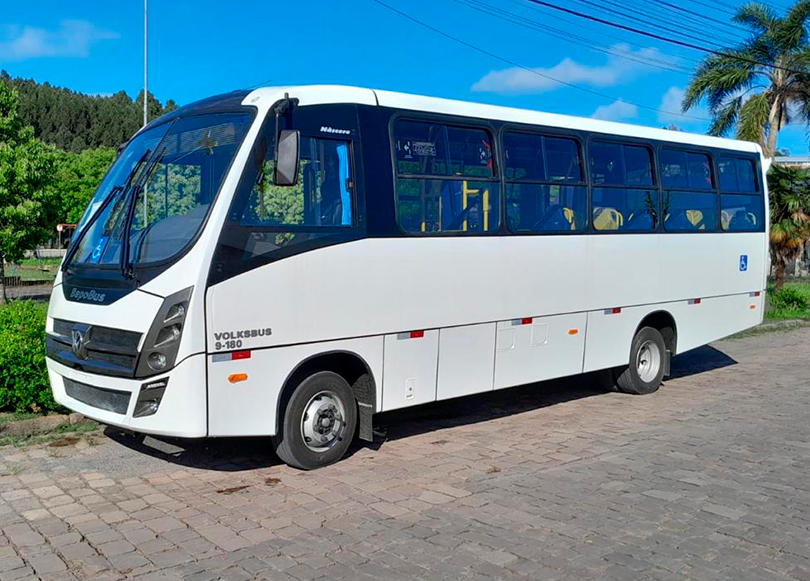
URBAN BUS-TYPE VEHICLE FOR 28 SEATS + DRIVER
A new bus (zero kilometer) – Year/Model: 2023/2023 or higher (chassis + body).
Engine: 3.8L – 175 HP – Proconve: P8 – Minimum GVW: 9000 KG
Maximum length: 9,850 mm
Minimum width: 2,370 mm
Maximum height: 3,090 mm (depending on the air-conditioning model)
Interior height: 1,960 mm
Entrance step height: 430 mm
Depth of access steps: min. 300 mm
Height of the riser of access steps: max. 300 mm
Wheelbase: variable according to the chassis used.
Passenger capacity: also variable according to the wheelbase.
Skirt height: 570 mm
Minimum corridor width: 350 mm (varies according to the seat model used and the 2x2 or 2x1 configuration).
Clear opening of the access door (min): 800 mm
Minimum window opening: 21% of the window (per mobile span)
Height of partitions in front of seats: 600 mm (without separation wall)
Maximum height from seat cushion to floor: 500 mm
Steering position: left side (or right side for RHD markets)
Engine location: front
Fuel tank in plastic (Polyethylene), original from the chassis, with varying capacities from 100 liters to 150 liters.
Passenger capacity and internal layouts according to specific floor plans of each chassis model and applicable legislation (National or International).
Structural components with thickness equal to or less than 2.70 mm in accordance with NBR 10735 ZAR 230 grade.
Structural components with thickness greater than 2.70 mm in accordance with standard (ABNT/SAE 1008/1010).
Bodies manufactured in fiberglass-reinforced plastic (fiberglass) in order to provide excellent final finishing as well as resistance combined with lower weight.
Side panels (below window line) in smooth aluminum, specific for body paneling, according to ABNT specifications 5052-H34 and/or 3004-H34.
The wheel arch contour must be covered with a fiberglass over-fender, painted in the color of the body.
The international flammability standards FMVSS302 (American) and CEE 95/28 (European) must be met, through presentation of reports.
All access doors must be manufactured with a steel profile structure.
External aluminum cladding ABNT 3105-H16 or 3004-H32, providing high resistance and low weight.
All bearings and supports are made of stamped steel.
The luggage compartment floor must be made of grooved aluminum sheets with 1.20 mm thickness according to ABNT 5052-H34.
Luggage compartment headers are also stamped aluminum and attached with rivets.
The front bumper must have vertical individual LED headlights, for better lighting angle for driver and pedestrians.
Spare tire compartment, mounted in the original chassis position when equipped with such a system, or in a suitable compartment located between the axles or at the rear of the vehicle.
Body structure protection:
● Galvanized steel profiles with zinc-rich paint in welded areas;
● Non-galvanized steel profiles painted with special structural primer type “zarcão”;
● Application of sealing compound at all contact points between aluminum sheets and structure;
● Application of anticorrosive and anti-noise “Underseal” compound, 1.0 mm thick, consisting of air-drying rubber-based composition, bitumen, aliphatic solvents, and specific fillers, applied to the lower parts, internal and external structures of the vehicle.
External protection and painting:
● Application of epoxy-amine sealing primer with 8 cm to 12 cm thickness;
● Application of base color with acrylic polyurethane enamel with 50 cm to 70 cm thickness;
● Oven drying between 65 to 75 °C;
● Application of additional colors with acrylic polyurethane enamel with 30 cm to 50 cm thickness;
All steel fastening elements such as bolts, pins, rivets, nuts, etc., must be protected against corrosion through zinc plating (zinc electro-deposition), chroming or equivalent method.
All windows must be tempered safety glass, colorless, with 4, 5 and 6 mm thickness and minimum transparency of 75%.
They must have approval certificates from AAMVA (American Association of Motor Vehicle Administrators) of the USA, ECE (Economic Commission for Europe) of the United Nations, and must also meet the parameters of ABNT NBR 9491, through presentation of the above certificates.
Windshields must be split or single-piece, green glass, aiming to minimize reflections from the interior of the vehicle, with thickness of 7 mm and minimum transparency of 75%, according to ABNT NBR 9491.
The body must be equipped with windows, being movable glass with rubber, with colorless tempered glass, fitted into aluminum frames, attached to the body by rubber profiles, and equipped with an easy-to-operate locking system, ensuring passenger safety.
All exits must be signaled with stickers containing clear operating instructions in 3 languages (Spanish, English, and Portuguese).
The floor may have 2 different compositions:
● Resin-coated marine plywood, 14 mm thick, covered with high-resistance flooring;
● Checker aluminum or aluminum covered with high-resistance flooring.
A report proving compliance with the standards ASTM E 662 – 17ªa standard, TECHNICAL INSTRUCTION Nº 10/2011 - NPT 010:2011 – ABNT NBR 9442:1986 must be submitted together with the commercial proposal; absence of reports proving compliance with the standards will result in disqualification of the bidder.
The cabin must have air-conditioning outlets in the upper section, sun visor with valance for the driver, and an ABC-type dry chemical fire extinguisher (minimum 4 kg).
The body must be equipped with a destination display (itinerary) in high-resolution LED panels, at the front and/or side and/or rear of the vehicle, according to the needs of each client.
The main interior lighting system must consist of LED-type fixtures, protected by a faceted acrylic white cover, mounted on the overhead racks (for highway vehicles), on air-conditioning ducts (for urban vehicles), and on the central ceiling (for rural vehicles), directed toward the central aisle, providing high luminosity.
Step/aisle lighting:
The lighting of the aisle and stairs must be obtained through fixtures conveniently installed and distributed along them, ensuring they do not interfere with passenger movement.
Reading lights:
To allow each passenger to read at night without disturbing others, the vehicle must be equipped with adjustable LED reading lamps located under the overhead racks above each passenger’s head, controlled by an individual switch.
All external lighting systems must comply with CONTRAN (National Traffic Council), DOT (USA), and ECE (European Common Market) standards.
The vehicle must be equipped with an internal rear-view mirror properly positioned in the upper part of the drivers cabin, allowing wide visibility of the interior and aisle.
External rear-view mirrors must comply with ECE 71/127 regarding visibility and arrangement on the body.
Each side of the body must receive a complete set with 2 convex lenses, with manual control.
The main lens of each support is Class II, as described in the ECE standard.
Mirror surface finishing must be produced through a metallization process, ensuring high-quality visibility.
Air-conditioning units must be installed on the roof of the vehicle or inside the passenger cabin.