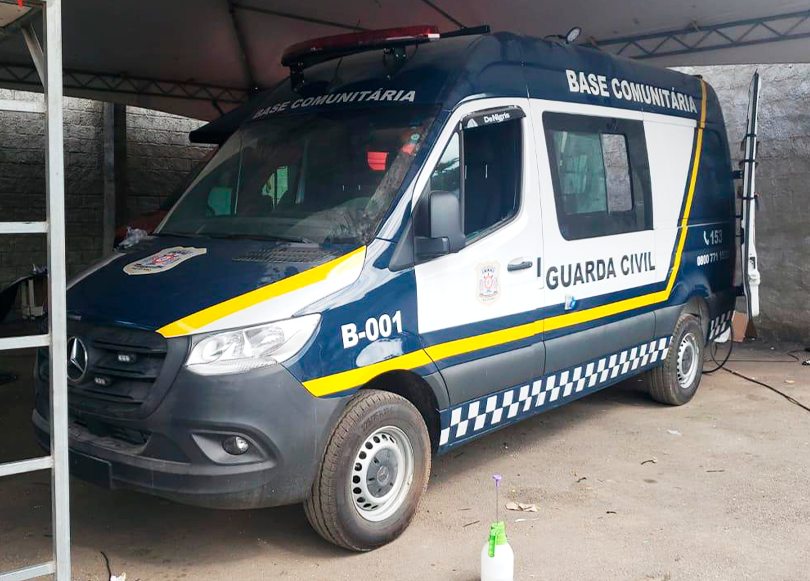
VEHICLE TYPE MOBILE BASE – VAN – MINIMUM 10.5m³ – 0KM.
Van-type vehicle, zero km, long and high roof – adapted for civil guard mobile base.
Specification: vehicle model: long van with high roof – 0km.
Capacity: minimum 06 people.
Color: white.
Engine: minimum power of 160 hp.
Fuel: diesel.
Transmission: gearbox: 6-speed manual.
Safety assistant: hydraulic disc brake on all wheels, with self-ventilated front discs.
Electronic Stability Program (adaptive ESP 9i®)
Active Brake Assist (ABA – Active Brake Assist)
Crosswind assist / hill start assist / fatigue alert
Adaptive brake lights
Hydraulic disc brake on all wheels.
Dimensions: wheelbase of at least 3660 mm.
Length of at least: 5900 mm.
Weight: gross vehicle weight (GVW) of at least 3,500 kg
Load capacity: at least 1800 kg
Steering: electric.
Minimum fuel tank: 65 l
Maximum Arla32 tank: 17 l
Traction: rear
Tires: 225 / 75 R16C tires
Tire armor: armor system.
Professional sealant for use in extreme situations as well as military vehicles.
Composed of kevlar fiber, aramid and ceramic, solid polymers and rubber.
High-performance physical shielding sealant (must not contain chemical adhesives or glues).
• (indeterminate shelf life),
• Must not contain glues or adhesives harmful to the wheel and tire assembly, allowing tire retreading.
Highly water-soluble.
• prevent and permanently repair punctures in tires without the need for further repairs
• repair already punctured tires.
• repair small bead fissures as well as porosity caused by retreading, which generate tire bubbles.
• reduce tire temperature by up to 30 degrees Celsius, through capillarity across the sidewalls and long calibration management.
• prevent loss of calibration, maintaining it for long periods (weeks/months).
Other items: air conditioning, dual airbag, power windows, power locks.
Adaptations for community mobile base.
Electrical system.
The electrical system must have the following characteristics:
operate at a nominal voltage of 12 V;
alternator with generation capacity compatible with the electrical demand needs of the vehicle;
flame-retardant wiring, with load conveniently distributed through circuits.
Second battery not less than 100 Ah.
The electrical system must include the following adaptations:
Battery charge limiter: system that interrupts the power supply to the accessories and installed equipment (except for the radio and the acoustic signaler) when the battery reaches the minimum limit charge sufficient to allow the vehicle to start; and,
the vehicle’s charging system must, in addition to its basic function, be sized to simultaneously support the original equipment and the adaptation of all the equipment and accessories provided in this specification and its attachments, observing the usage criteria adopted by the municipal civil guard, defined as follows:
10% of the period corresponds to the vehicle in motion and 90% to the vehicle parked, and in this latter situation the vehicle remains with its engine switched off;
during the vehicle’s operation time, the mobile transceiver will remain on, being used to transmit messages 10% of the time.
The vehicle battery to be supplied shall be of the “sealed” type, with a capacity not less than 100 Ah, meaning it requires no maintenance (replacement of the solution).
Painting and graphics:
The vehicles must be painted as determined by the municipal department of public safety.
The vehicles shall receive graphics according to the model, specifications, and locations established by the contracting party.
The visual identification (graphics) of the patrol unit must be applied by the company contracted to perform the transformation according to the standard adopted by the institution and will consist of special paint (varnish), to be applied over the vehicle, standard characterization paint, and identifying stickers;
the identification determined by the municipal guard must be applied to the vehicle.
The special paint (varnish) must be acrylic polyurethane varnish, two-component, extra-fast drying and high gloss, highly resistant to weathering, suitable for application over smooth polyester base, without color alteration:
the special paint (varnish) must be applied after the application of the characterization paint and the identifying stickers;
the special paint (varnish) shall only be applied after the inspection and approval of the adhesive identifiers by the adaptation monitoring committee.
The contracted company must present a certificate issued by the manufacturer of the self-adhesive films, indicating the brand and model of the product used in the graphic design and attesting to its full compliance with the requirements of this specification.
The checkered adhesive on the lower side area must be reflective film.
On top of the special paint, the identifying stickers shall be affixed, as described below, noting that the letters, numbers, and the telephone symbol shall be made in reflective vinyl and the logos in non-reflective vinyl.
Miscellaneous prescriptions:
The institution’s graphic standard (color pattern and the layout for applying colors and stickers) shall be provided by the municipal department of public safety.
(Note: painted vehicles must not show finish steps; they must be sanded and polished after painting).
Digital vehicular transceiver, in VHF-FM, with integrated GPS receiver. The present specification establishes the minimum technical requirements that must be observed for the supply of mobile vehicular transceivers operating in the VHF band, used in mobile telecommunications systems.
Each station shall be supplied with the following items:
01 transmitter-receiver radio equipment;
01 GPS module incorporated into the equipment;
01 handheld microphone with transmission key;
01 programming cable for the equipment;
01 update of the Turbonet system (management system for the municipal guard radios);
Power supply unit:
01 power cable assembly and mounting bracket;
01 front loudspeaker;
01 ¼-wave whip antenna, 0 dB gain, for mounting on the vehicle roof;
01 (one) embedded GPS antenna on the vehicle dashboard;
Frequency range: 1575;
VSWR: RF (radiofrequency) control through electronic synthesizer;
Electronic protection against: RF impedance variation due to antenna mismatch; transmitter power excess above the nominal limit of the model; and continuous transmitter activation for a time longer than permitted, recyclable at each activation, with audible “time expired” warning (T.O.T), being programmable externally via PC.
Electronic memory for programming/reprogramming the operating frequency(ies) and operational features, by external access via PC.
Transmitter specifications:
Nominal RF power (minimum): 45 watts with reduction by programmable adjustment via PC down to 25 W;
Frequency stability (-10°C to +60°C): better than or equal to ± 0.5 ppm;
Deviation: ± 5 kHz @ 25 kHz for 100% modulation measured with 1 kHz tone;
Transmission consumption: maximum of 14.5 amperes at full power (in DC);
Audio response: 300 to 3000 Hz;
Audio distortion: better than or equal to 3%;
Digital vocoder: AMBE 2+.
Receiver specifications:
Analog sensitivity: better than or equal to 0.30 µV @ 12 dB SINAD;
Digital sensitivity: better than or equal to 0.30 µV @ 5% BER;
Frequency stability (-10°C to +60°C): better than or equal to ± 0.5 ppm;
Selectivity: better than or equal to 80 dB @ 25 kHz, better than or equal to 65 dB @ 12.5 kHz;
Intermodulation: better than or equal to 78 dB;
Spurious rejection: better than or equal to 75 dB;
Audio output: minimum of 3 watts.
Signaling and control features:
The receiver squelch opening shall be programmable and externally selectable via PC, with the following options:
Analog mode:
Carrier (CS)
Analog sub-tone (CTCSS or PL or TPL).
Digital sub-tone (DCS or DPL)
Digital mode:
Up to 15 system signaling codes;
Power supply unit signaling:
Analog: high-speed FSK signaling (1200 bauds): automatic identification transmission (PTT-ID).
Emergency transmission.
Call alert reception.
Digital functions:
Group calls
Private call
Remote monitor
PTT-ID
Radio inhibition
Radio check
Call alert
Emergency alarm.
Specification of the acoustic-visual signaling assembly:
Visual signaling system:
Main light assembly, consisting of a signaling bar in linear, arc, or similar format, equipped with a ruby-red polycarbonate injection-molded dome (single module with single lens or sequential modules occupying 100% of the signaler size), impact- and discoloration-resistant, UV-treated, to be mounted on the roof of the police vehicle, aligned with the “B” pillar, using a base made of black extruded aluminum, not exceeding the maximum width of the vehicle roof, ensuring officer physical safety during boarding and disembarking, as well as other usual operations, as defined during prototype development and approval.
Light source composed of LED modules, specific for illumination, in ruby-red color, distributed to allow full 360º visibility without blind spots; the LED modules must be interchangeable among themselves; the modules shall include collimating-diffusing lenses made of engineering plastic with automotive resistance and high visibility, being directive in central modules and diffusive in side modules; each LED shall meet the following specification:
Nominal supply: 12 VDC;
Category: AlInGaP;
Predominant color: red (620 to 630 nm);
Luminous intensity: not less than 40 lumens;
Power: not less than 1 W and not greater than 2 W;
Acoustic signaling system:
Electronic siren with amplifier of at least 100 W and single sound-projecting unit, with at least 4 tones (patrol, emergency, priority passage, and passage blockade) – (MAN and HORN), generating sound pressure not less than 120 dB at 01 (one) meter distance, which shall be properly installed inside the engine compartment; the driver used must be appropriate for use in police vehicles, and must allow maintenance by the contracting party, with specific mounting points for the horn. Control module: module to be installed on the front panel of the vehicle, for the purpose of controlling, in an integrated manner, the entire acoustic and visual signaling system of the patrol vehicle, equipped with a microprocessor or controller that allows the generation of ultra-high-frequency light flashes, with a cycle not less than 04 (four) flashes every 100 ms, shall have a maximum of 15 buttons for activating the functions, with inscriptions in the Portuguese language; the electronic circuit shall manage the electrical current applied to the LEDs through PWM (pulse width modulator), in order to guarantee the service life of the LEDs and the luminous efficiency of the signaler, even when the vehicle is turned off or at low rotation.
The control module shall have the capacity to generate lighting effects that characterize the vehicle as stationary, in motion, and in an emergency situation, which may be activated separately or simultaneously.
Miscellaneous prescriptions: the system shall be immune to EMI (electromagnetic interference) and RFI (radio frequency interference) or any other form of signal that interferes with the reception of the transceivers within the frequency range used by the GCM; the system shall have a low-voltage sensor to prevent operation of the signaler when the battery reaches the minimum capacity (10.8 V), so as to allow engine start; the maximum energy consumption, with the entire lighting system activated, shall not exceed 5 A/h under nominal supply conditions; the system shall have protection against polarity inversion, high voltage variations and transients, and shall shut down preventively when the voltage exceeds limits that endanger equipment safety;
Upon approval of the prototype, the contracted company shall present the following documents: certificate issued by the manufacturer and/or LED supplier proving that the products used in the signaling system comply with the present specification;
Auxiliary intermittent and stroboscopic lighting system:
04 (four) mini signalers, being one pair in red and one pair in blue installed at the rear part of the front grille (hidden) and 2 (two) mini signalers housed near the rear lamps or in a location to be defined together with the GCM monitoring team, according to the brand/type/model of the vehicle, with at least 3 LEDs of 1 W, sealed in linear or circular format, with finishing ring in black color; synchronized face-to-face with the pre-defined colors. Application voltage: 12 to 14.7 VDC.
It is forbidden to install strobe lamps inside the vehicle headlights and tail lights. The control of the auxiliary signalers shall be on the same control module as the signaling bar and siren. The mini signalers shall be sealed to prevent contact with moisture.
Other requirements:
Amplifier and megaphone system with auxiliary audio interface and interconnection with the radio transceiver. The control module shall allow the generation of lighting effects that characterize the vehicle as stationary, in motion, in patrol, and in emergency, which shall be activated separately. The system shall not generate electromagnetic noise (EMI) or any other form of signal that interferes with transceiver reception, and shall be immune to radio frequency, generating no interference, especially when receiving or transmitting messages or data.
The entire acoustic-visual signaling assembly shall be delivered fully installed, with a warranty of full operation for at least 24 months.
Rear compartment.
The rear compartment shall be adapted to enable the use of the vehicle as a mobile community base and the transportation of at least 08 (eight) passengers, with safety, noting that:
The set described below shall integrate perfectly with the internal layout of the vehicle, and no points shall be admitted that may cause injury to its users;
The junction points of the pieces forming the set, as well as those between the set and the vehicle, shall receive sealing with appropriate material;
The pieces forming the set shall receive adequate fastening so that no movement, cracks or noises occur;
The interior of the compartment shall have the gray color tone, ranging from light tone (internal lining and table top), medium tone (floor and sides of the storage bench) to the darkest tone (seats and backrests of the storage bench, front seat covers);
The furniture that will integrate the rear compartment shall be manufactured and installed observing proportionality.
Internal structure:
The internal structure shall have the following characteristics:
Internal lining (sidewalls and ceiling) in laminated or Formica-type washable material, allowing easy cleaning and sanitation, with rounded and sealed corners;
Internal thermo-acoustic lining (sidewalls and ceiling), made of expanded polyurethane not less than 05 mm thick;
Floor made of marine plywood, fully covered with synthetic, washable and non-slip material;
02 (two) side sliding windows, with dimensions not less than 900 mm in width and 500 mm in height, one on the sliding door on the right side and another in symmetry to it on the left side, equipped with locks and transparent glass (similar to the original of the vehicle), allowing the entry of natural light and air circulation in the compartment;
02 (two) rear sliding windows, located on both leaves of the rear doors, equipped with locks and transparent glass (similar to the original of the vehicle), allowing the entry of natural light and air circulation in the compartment;
02 (two) grab handles, made of aluminum tubing, with diameter of 1¼ inches, installed longitudinally on the ceiling of the compartment, above the storage-type benches;
02 (two) storage-type benches, made of 15 mm marine plywood, coated in Formica, with rounded corners and PVC trim, equipped with 02-point seat belts for all occupants, upholstered seats and backrests covered with washable synthetic material, to be installed longitudinally along the rear compartment sidewalls, and shall also have dimensions not less than 500 mm in depth and 450 mm in height, in addition to the length proportional to the dimension of the vehicle’s rear compartment, according to figure 1 letter “d” and letter “e”;
Desk-type table, made of 15 mm marine plywood, coated in Formica, with rounded corners and PVC trim, with dimensions not less than 400 mm in width and maximum height of 750 mm, in addition to maximum length of 1000 mm, proportional to the dimension of the rear compartment of the vehicle, according to figure 1 letter “c”;
Cabinet, made of 15 mm marine plywood, externally coated in Formica, with rounded corners and PVC trim and internally coated in rubber, with dimensions of 400 mm width, not less than 800 mm length and height not less than 700 mm and maximum of 1000 mm, to be installed on the partition wall located between the cabin and the rear compartment, with the purpose of storing, through a side door, a foldable metal table and three foldable metal chairs. On the upper part of the cabinet there shall be a drawer and on the lower part 02 storage compartments.
Electrical part:
The electrical part shall have the following characteristics:
01 (one) voltage inverter from 12V to 110/220V, with a minimum power of 400W;
02 (two) fans / exhaust fans installed on the roof of the vehicle;
04 (four) fluorescent luminaires, of no less than 20 W, internally fixed to the ceiling of the compartment, with dual independent circuit;
04 (four) external luminaires, in crystal color, with independent activation, installed in such a way that 03 (three) illuminate the area under the awning when it is deployed, and another that illuminates the left side of the vehicle, with dual independent circuit;
04 (four) outlets powered by the inverter, being 03 (three) 110V and 01 (one) 220V, positioned at the lower part of the left side of the vehicle, between the desk and the front cabinet;
03 (three) outlets powered through external energy supply, positioned on the left side of the vehicle, being 02 (two) above the front cabinet of the divider and another on the lower part, between the desk and the front cabinet;
External outlet with sealed cover for capturing 110/220 V energy, which enables the powering of the entire electrical system of the rear compartment;
02 (two) 12 VDC outlets, cigarette-lighter type, to be installed on the right side of the vehicle, near the sliding door, and another on the left side of the vehicle, near the door;
Independent auxiliary battery set that provides a minimum autonomy of 06 (six) hours to power devices operating at 110VAC and 12VDC, to be housed in a single compartment located inside the left storage-bench;
Equipment that allows monitoring of the charge available in the battery set;
Portable battery charger, which allows simultaneous recharging of the battery set through external power at 110/220 V;
Cable for power supply from the external network and charging of the auxiliary batteries, with a minimum length of 25 meters, to be stored in a dedicated reel, properly fixed inside the right storage-bench;
The electrical system shall be dimensioned observing the following:
The equipment to be installed in the rear compartment shall operate with alternating or direct voltage, with alternating voltage obtained via external supply or voltage conversion (input 12VDC, output 110/220VAC) that meets the power demand of the loads adapted to 110VAC, or direct voltage obtained through the auxiliary batteries;
The vehicle’s original battery shall be isolated, not being used as a power source for any devices installed in the vehicle;
The electrical assembly of the system shall be carried out with automotive-standard conduits.
The wiring of the system shall be embedded in the side coverings and cabinets of the vehicle, so that they are not visible, being fixed and accommodated in such a way as not to generate noise with the movement of the vehicle, and the entire electrical system shall be physically identified in order to facilitate future maintenance.
One 12V outlet (cigarette-lighter type) for powering the search spotlight, installed on the rear door pillar;
Control panel (on/off), for activation of internal and external lighting.
Other accessories and equipment.
The accessories and equipment shall have the following characteristics:
External awning, manufactured in polyester mesh coated with PVC, with minimum dimensions of 3,000 mm in length and 2,000 mm in width, mounted on a pantographic aluminum structure, operated by means of a worm screw and roll-up crank, to be fixed on the upper side of the bodywork through an internal steel structure, resistant to vibrations and weather conditions, not allowing the use of L-brackets.
The main part of the awning shall contain, in serigraphic application, the emblem of the Municipal Civil Guard printed in an area not smaller than 1.00 m², in addition to the words “base comunitária móvel” printed on the fringe of the piece.
Rear warning signaling system, consisting of 02 (two) rotating beacons in red and 01 (one) rear signaling bar for direction indication, composed of 07 (seven) independent modules, in amber color, with sequential or intermittent activation, installed at the rear end of the vehicle roof.
01 (one) audible reverse alarm, 12 V, with two intensity levels, with sound pressure not lower than 100 dB;
01 (one) swivel upholstered seat, rigidly fixed to the floor, installed between the service desk and the storage compartment, equipped with a seat belt;
01 (one) foldable metal table in white color;
03 (three) foldable metal chairs in white color;
10 (ten) traffic cones, manufactured in rubber in orange color, with 02 (two) reflective stripes and height not less than 500 mm, to be stored inside the left side bench;
01 (one) “no smoking” sticker to be installed inside the rear compartment;
i) 02 (two) stickers “proibido trafegar o veículo com a porta aberta” (“it is forbidden to operate the vehicle with the door open”) to be installed on the inner part of the doors located in the rear compartment of the vehicle.
Monitoring system composed of 4 cameras and DVR:
A camera monitoring system shall be installed in the vehicle cabin, resistant to vehicle vibration, in a location easily visible to the occupants of the cabin, with sealed connections to prevent disconnection, and with accessible maintenance.
The purpose of the system is to provide greater safety to the officers.
The system shall present the following characteristics:
a) 04 (four) cameras of the X-Man type, metallic, with avionics-type connectors, color, minimum resolution AHD 720p, with built-in infrared illumination and IP-66 protection rating, being:
02 (two) cameras with 2.8 mm lenses at the front and upper rear exterior, with rear-view capability, and 02 (two) cameras with 1.8 mm lenses installed in such a way that from the cabin it is possible to view both sides.
All cables required for proper connections shall be supplied.
The cameras shall be protected by an anti-vandalism solution to be implemented on the external body of the vehicle.
Residential-type cameras shall not be accepted, nor anti-vandalism solutions of the “dome” type.